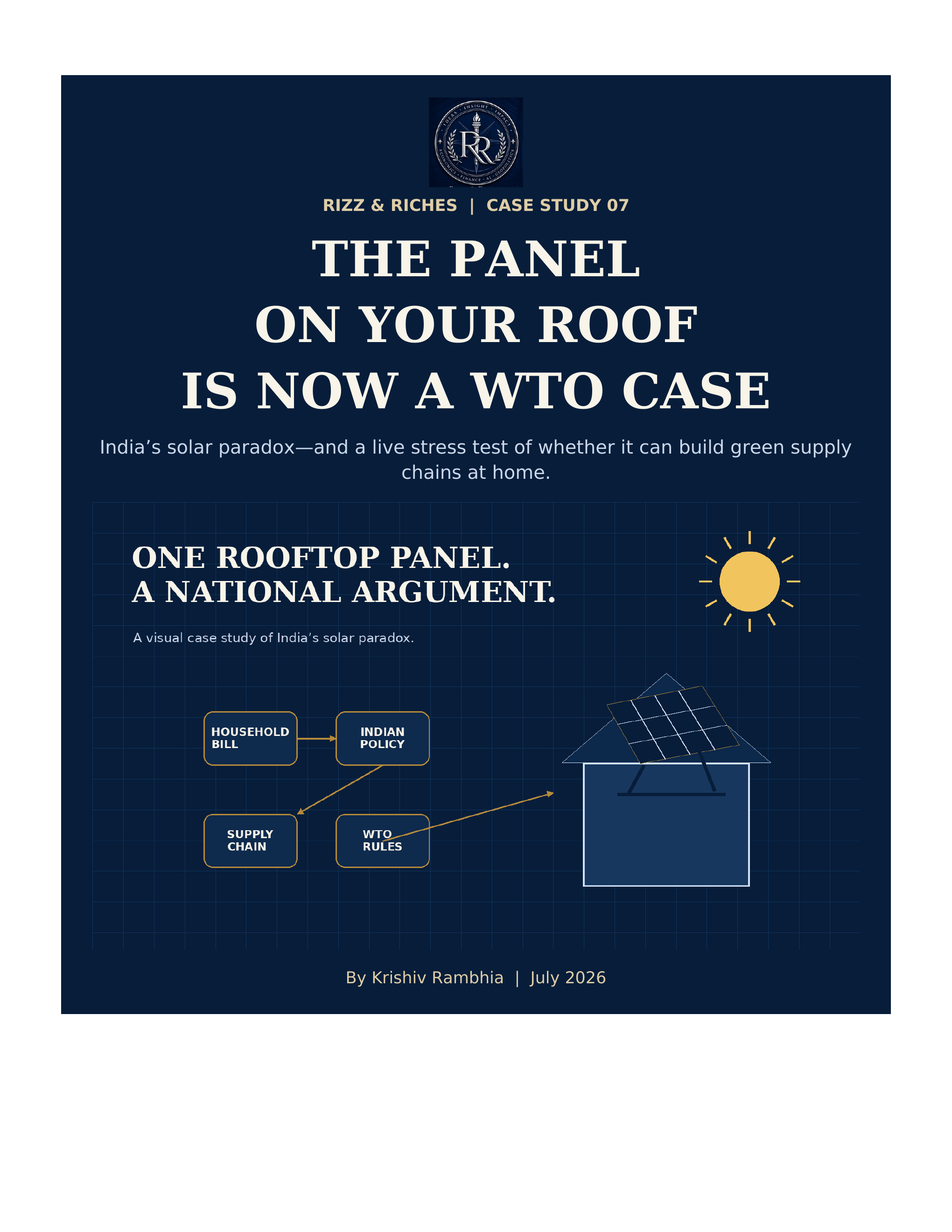
The Panel On Your Roof Is Now A WTO Case
DS644 is not just a dispute over solar panels. It is a live stress test of whether India can build domestic green and technology supply chains without letting industrial policy turn into permanent protectionism.
- Research date
- July 5, 2026
- Reading time
- 7 min read
30-second takeaway
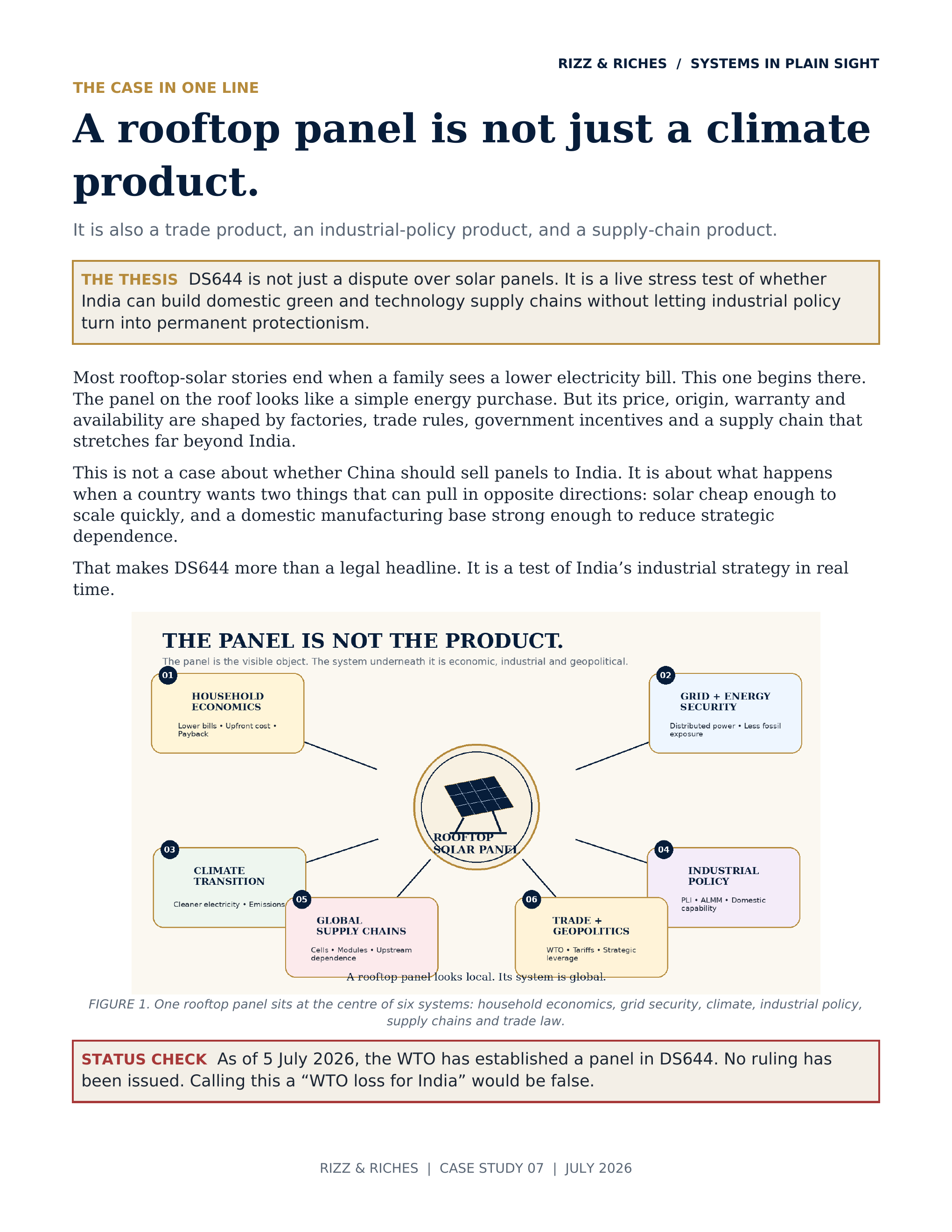
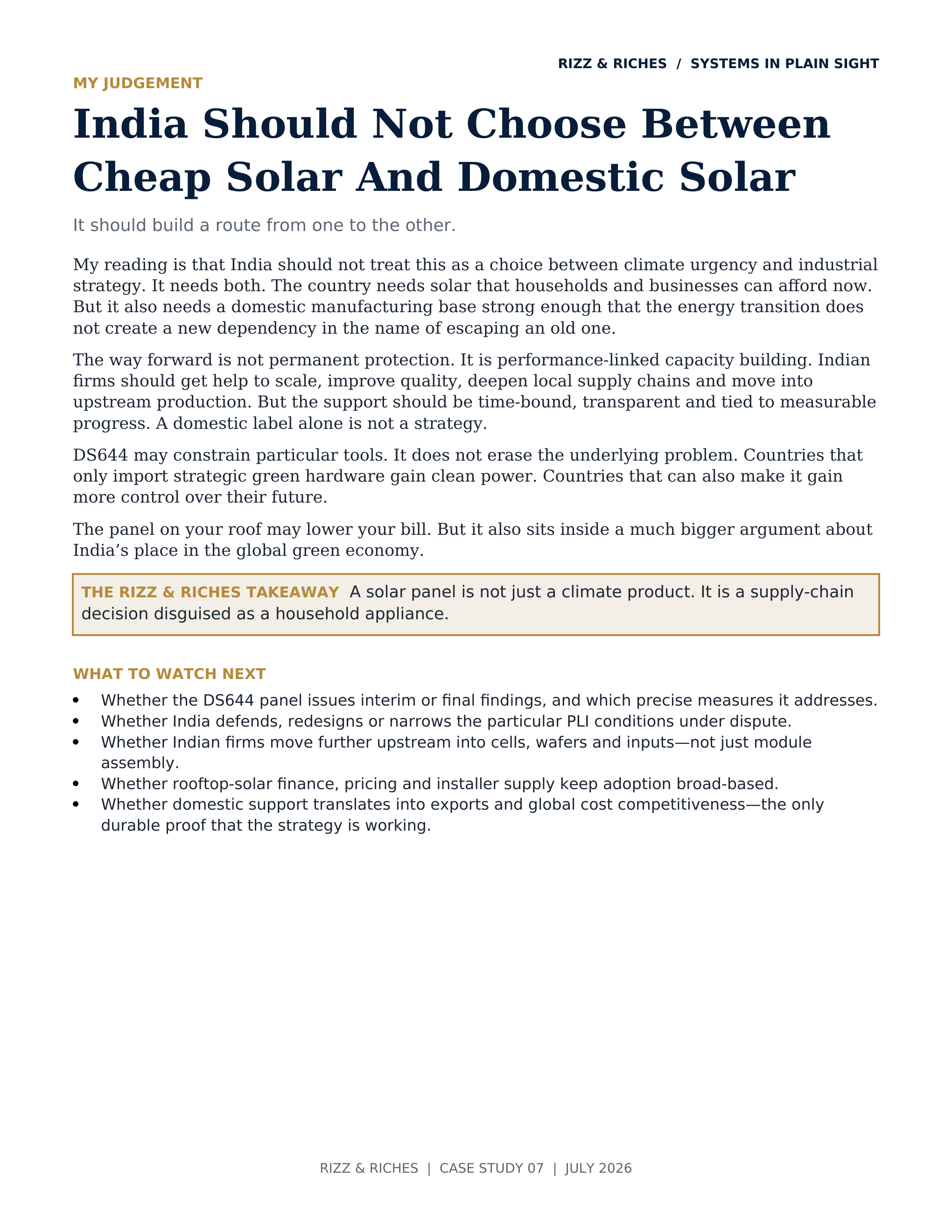
A solar panel is not just a climate product. It is a supply-chain decision disguised as a household appliance.
System Map
Use the article sections to trace the trigger, transmission, hidden dependency and impact.
The Trigger
DS644 is bigger than a solar case.
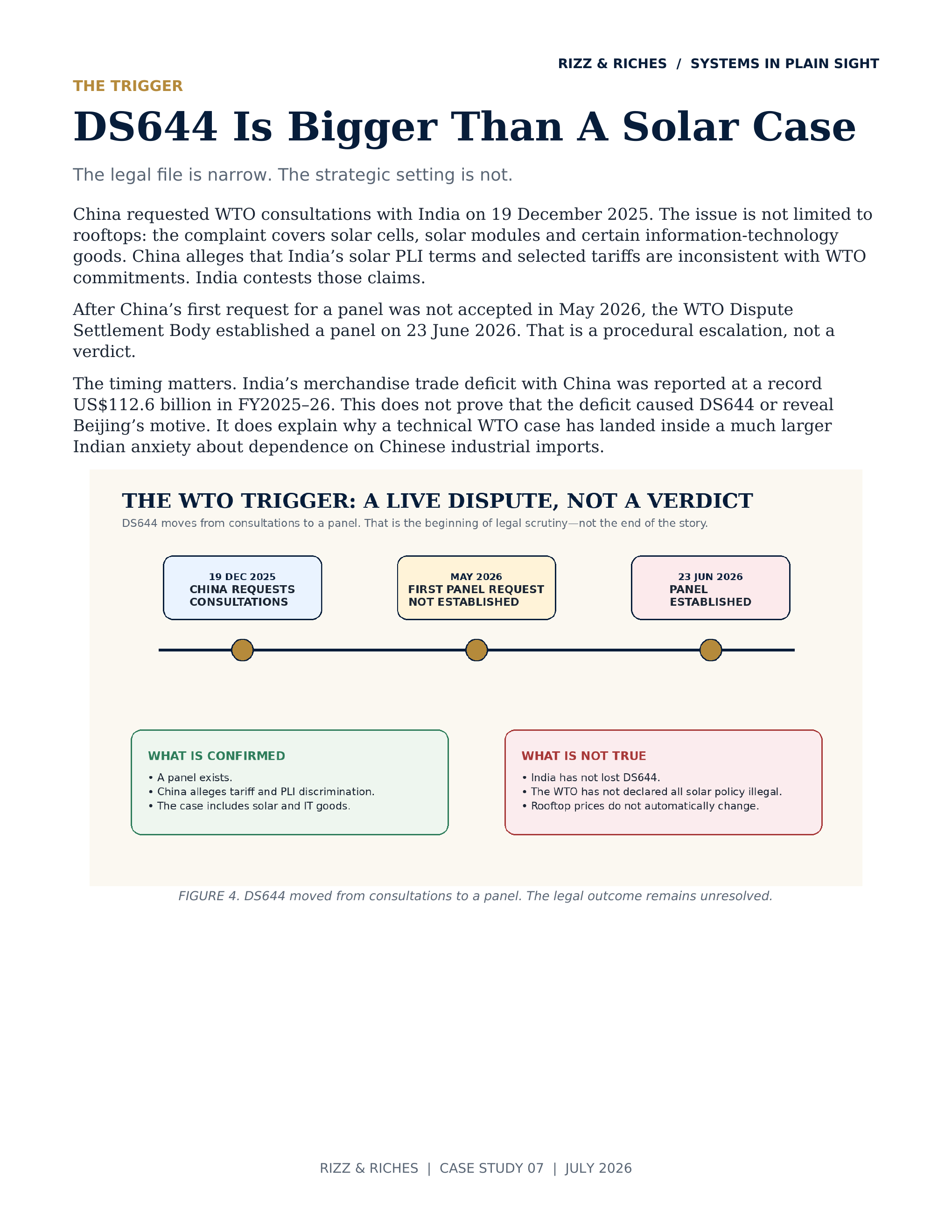
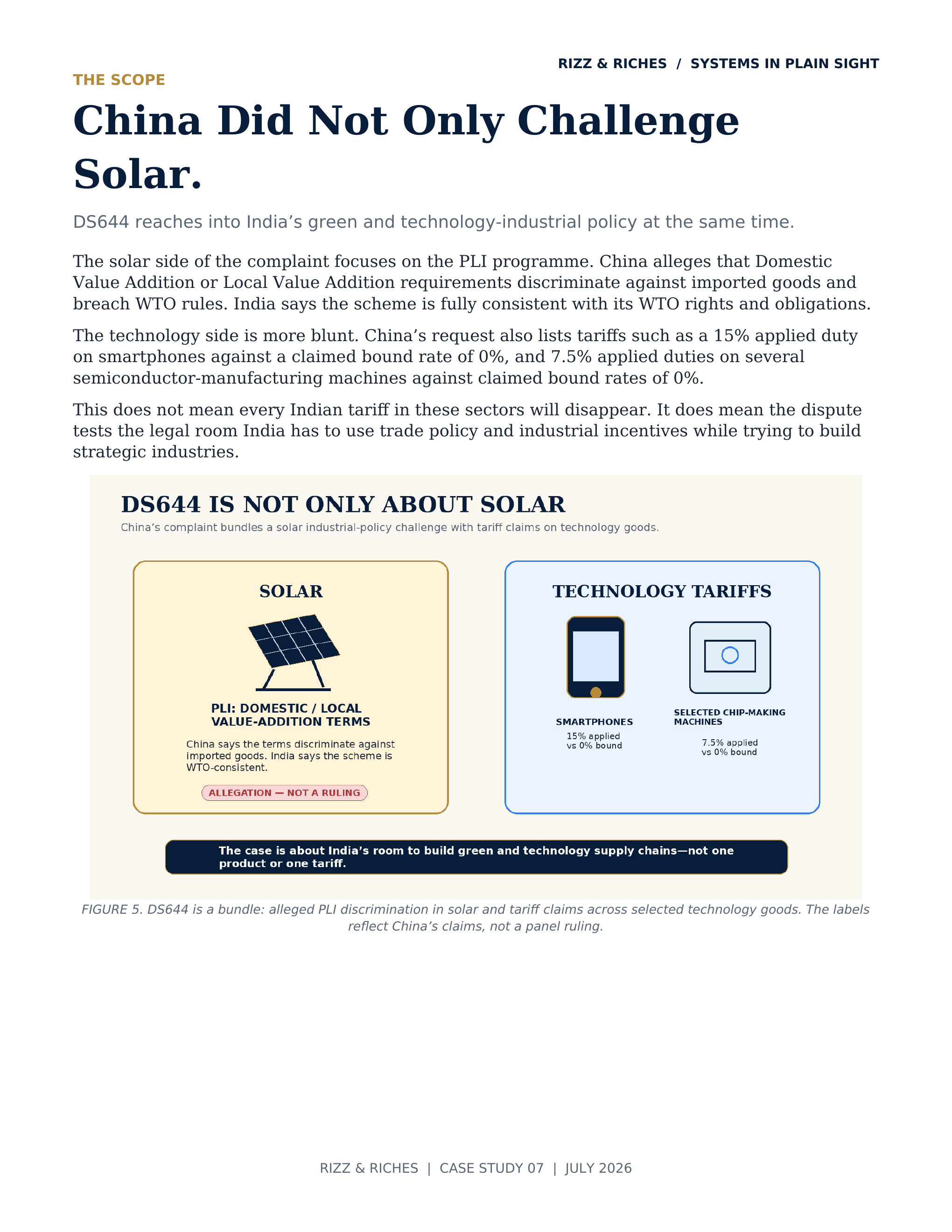
China requested WTO consultations with India on 19 December 2025. The issue is not limited to rooftops: the complaint covers solar cells, solar modules and certain information-technology goods. China alleges that India’s solar PLI terms and selected tariffs are inconsistent with WTO commitments. India contests those claims.
After China’s first request for a panel was not accepted in May 2026, the WTO Dispute Settlement Body established a panel on 23 June 2026. That is a procedural escalation, not a verdict.
As of 5 July 2026, the WTO has established a panel in DS644. No ruling has been issued. Calling this a “WTO loss for India” would be false.
The timing matters. India’s merchandise trade deficit with China was reported at a record US$112.6 billion in FY2025-26. This does not prove that the deficit caused DS644 or reveal Beijing’s motive. It does explain why a technical WTO case has landed inside a much larger Indian anxiety about dependence on Chinese industrial imports.
The Transmission
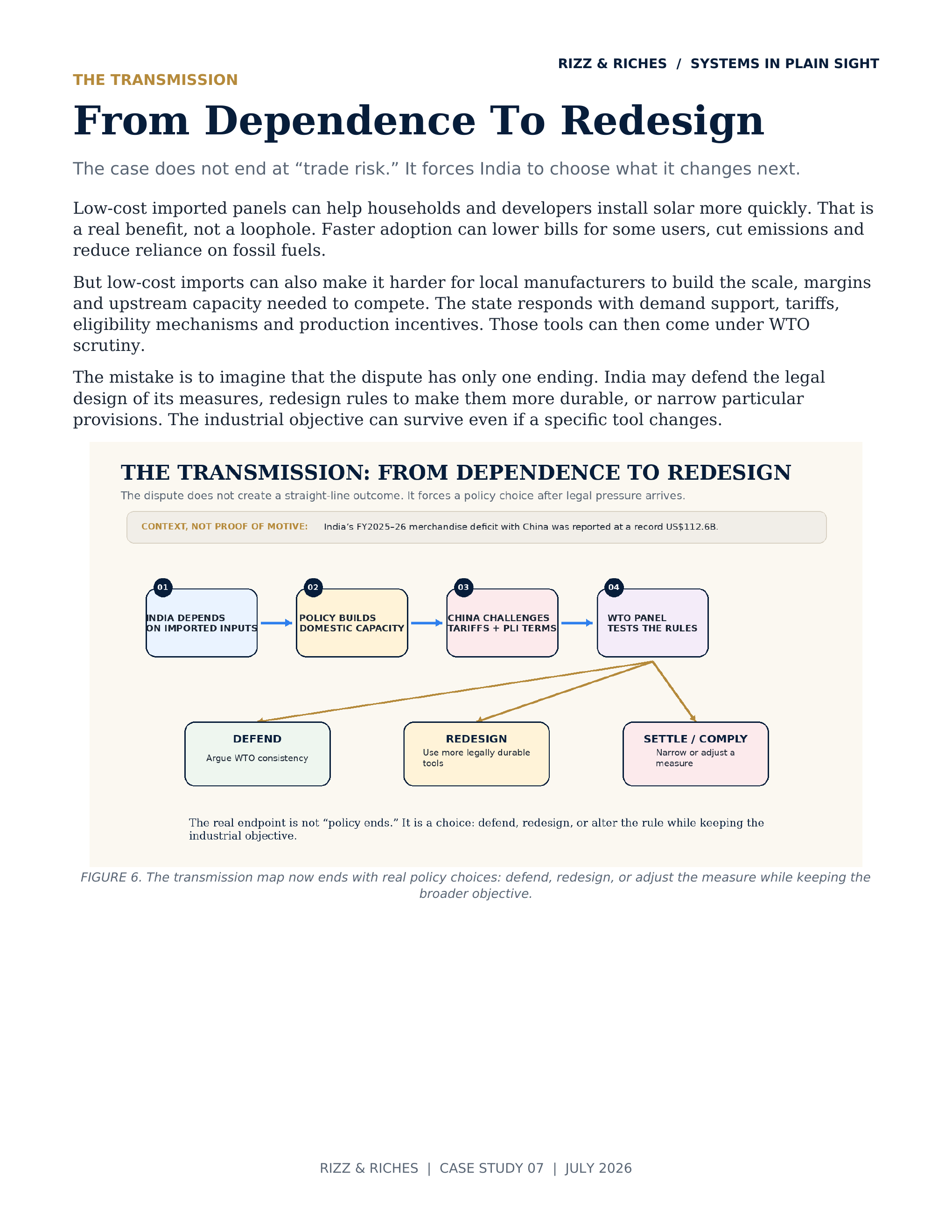
The case does not end at “trade risk.” It forces India to choose what it changes next.
Low-cost imported panels can help households and developers install solar more quickly. That is a real benefit, not a loophole. Faster adoption can lower bills for some users, cut emissions and reduce reliance on fossil fuels.
But low-cost imports can also make it harder for local manufacturers to build the scale, margins and upstream capacity needed to compete. The state responds with demand support, tariffs, eligibility mechanisms and production incentives. Those tools can then come under WTO scrutiny.
The mistake is to imagine that the dispute has only one ending. India may defend the legal design of its measures, redesign rules to make them more durable, or narrow particular provisions. The industrial objective can survive even if a specific tool changes.
The Hidden Dependency
A rooftop panel is not just a climate product. It is also a trade product, an industrial-policy product and a supply-chain product.
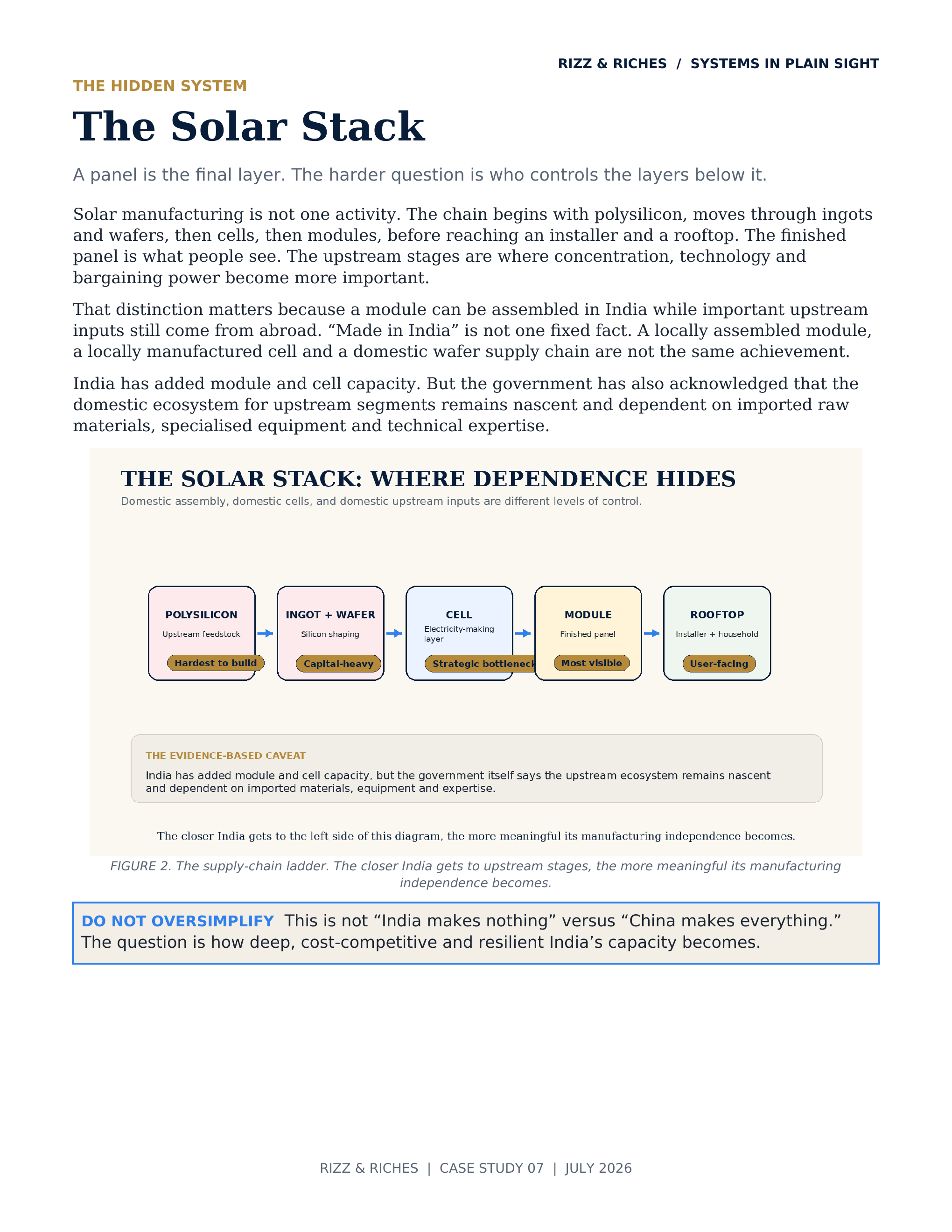
Solar manufacturing is not one activity. The chain begins with polysilicon, moves through ingots and wafers, then cells, then modules, before reaching an installer and a rooftop. The finished panel is what people see. The upstream stages are where concentration, technology and bargaining power become more important.
That distinction matters because a module can be assembled in India while important upstream inputs still come from abroad. “Made in India” is not one fixed fact. A locally assembled module, a locally manufactured cell and a domestic wafer supply chain are not the same achievement.
India has added module and cell capacity. But the government has also acknowledged that the domestic ecosystem for upstream segments remains nascent and dependent on imported raw materials, specialised equipment and technical expertise.
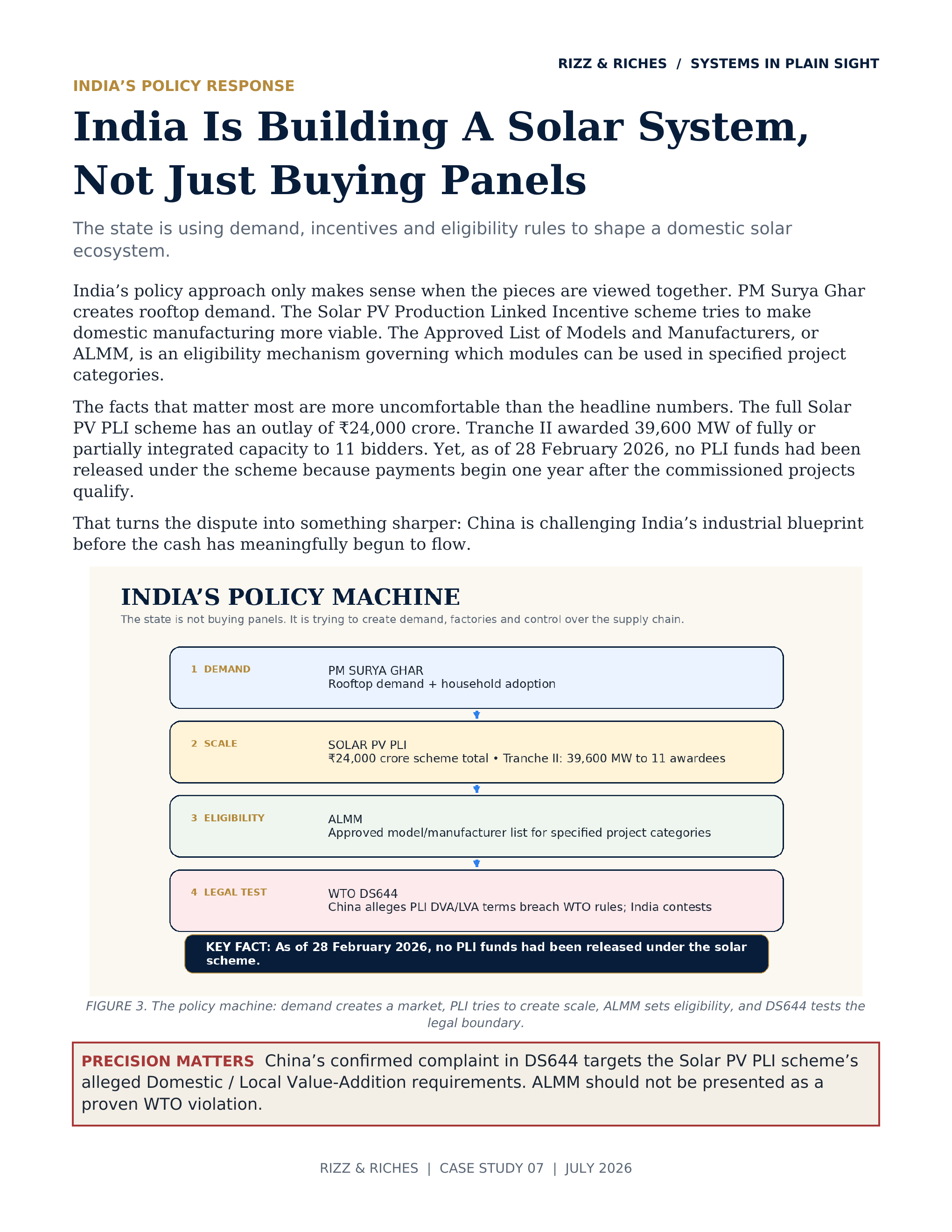
India’s policy response only makes sense when the pieces are viewed together. PM Surya Ghar creates rooftop demand. The Solar PV Production Linked Incentive scheme tries to make domestic manufacturing more viable. ALMM is an eligibility mechanism governing which modules can be used in specified project categories.
The full Solar PV PLI scheme has an outlay of Rs 24,000 crore. Tranche II awarded 39,600 MW of fully or partially integrated capacity to 11 bidders. Yet, as of 28 February 2026, no PLI funds had been released under the scheme because payments begin one year after the commissioned projects qualify.
Quiet Winners
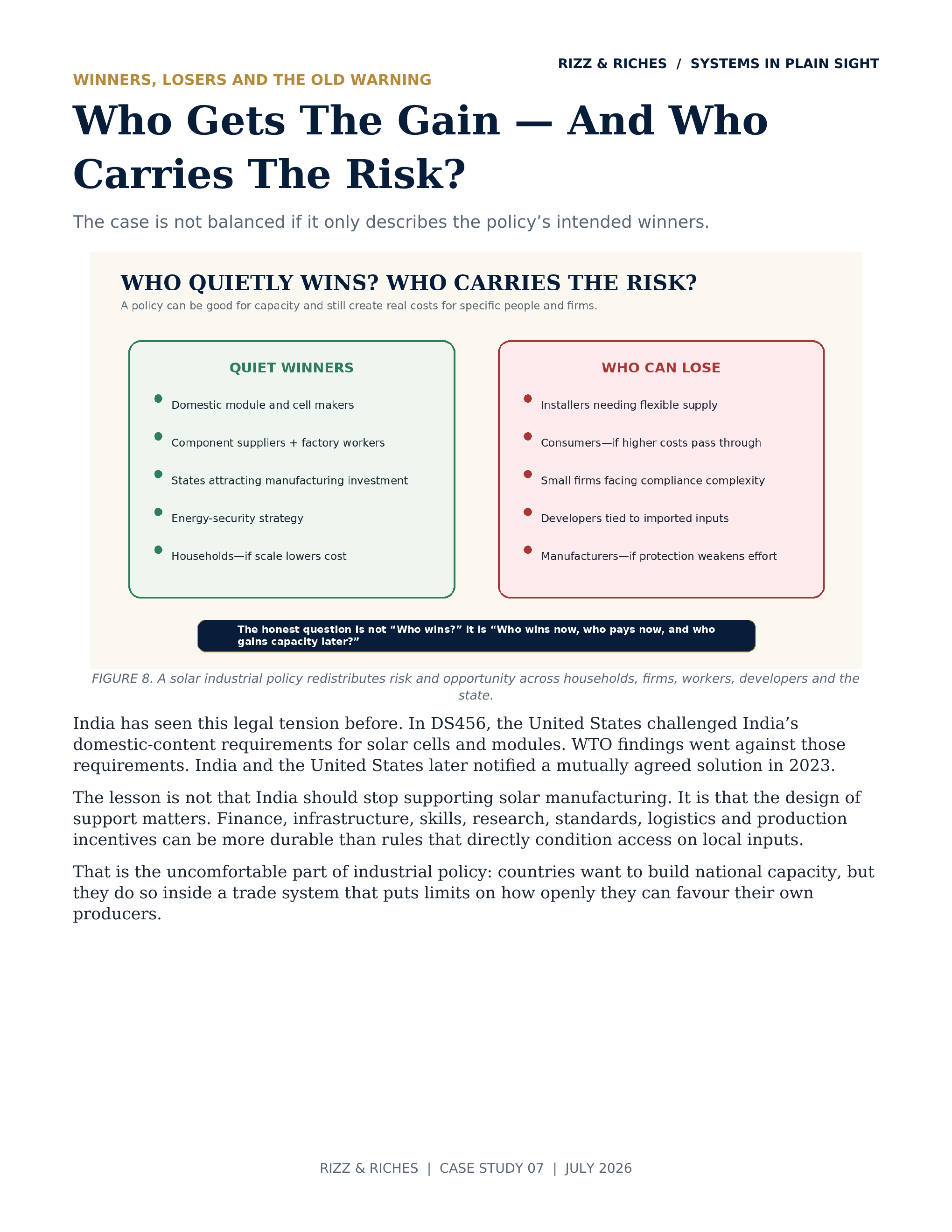
The policy’s intended winners include Indian solar manufacturers, workers and firms that can move deeper into the solar supply chain. The broader opportunity reaches manufacturing, engineering, testing, installation, finance and grid management.
Households and developers can also benefit from low-cost imported panels when they make solar adoption faster or cheaper. Faster deployment can lower bills for some users, cut emissions and reduce reliance on fossil fuels.
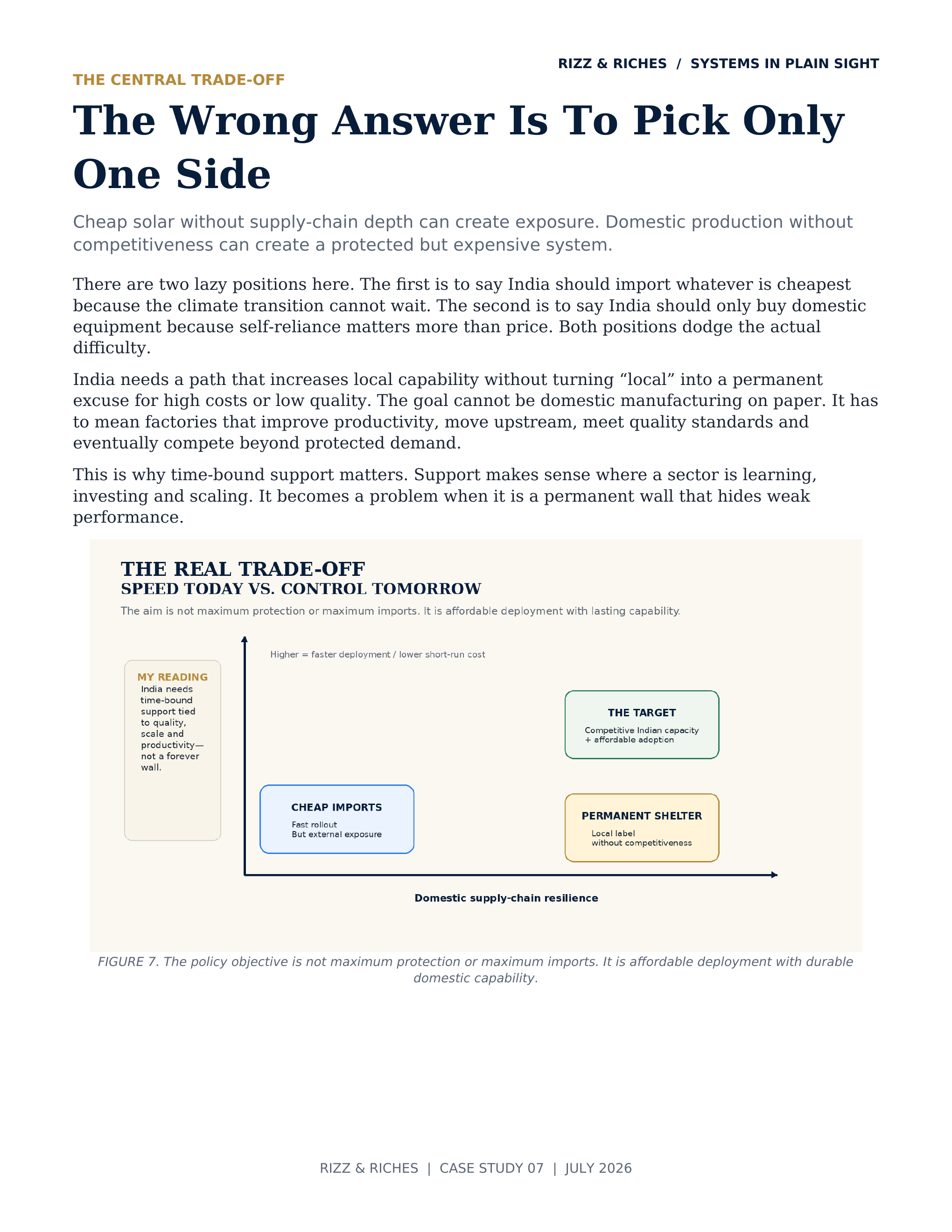
The case study’s central warning is that India should not choose between cheap solar and domestic solar. It should build a route from one to the other.
Quiet Losers
The risk is unevenly distributed.
Low-cost imports can make it harder for local manufacturers to build the scale, margins and upstream capacity needed to compete. On the other side, domestic production without competitiveness can create a protected but expensive system.
The wrong answer is to pick only one side. Cheap solar without supply-chain depth can create exposure. Domestic production without competitiveness can create a protected but expensive system.
India has seen this legal tension before. In DS456, the United States challenged India’s domestic-content requirements for solar cells and modules. WTO findings went against those requirements. India and the United States later notified a mutually agreed solution in 2023.
The lesson is not that India should stop supporting solar manufacturing. It is that the design of support matters. Finance, infrastructure, skills, research, standards, logistics and production incentives can be more durable than rules that directly condition access on local inputs.
India / Youth Relevance
For a young Indian, this case sits at the intersection of clean energy, manufacturing jobs, household affordability and geopolitical power.
PM Surya Ghar aims to support rooftop solar on one crore residential households by FY2026-27. That is why rooftop solar is no longer a niche question. It is becoming part of India’s mainstream infrastructure story.
The deeper question is whether India becomes only one of the world’s largest buyers of solar hardware, or also becomes a competitive maker of it. The answer affects jobs in manufacturing, engineering, testing, installation, finance and grid management. It also affects how much control India has over the hardware it needs for its future electricity system.
The key insight: the green transition is not only about replacing coal with sunlight. It is also about deciding who owns the factories, the supply chains and the leverage behind the sunlight.
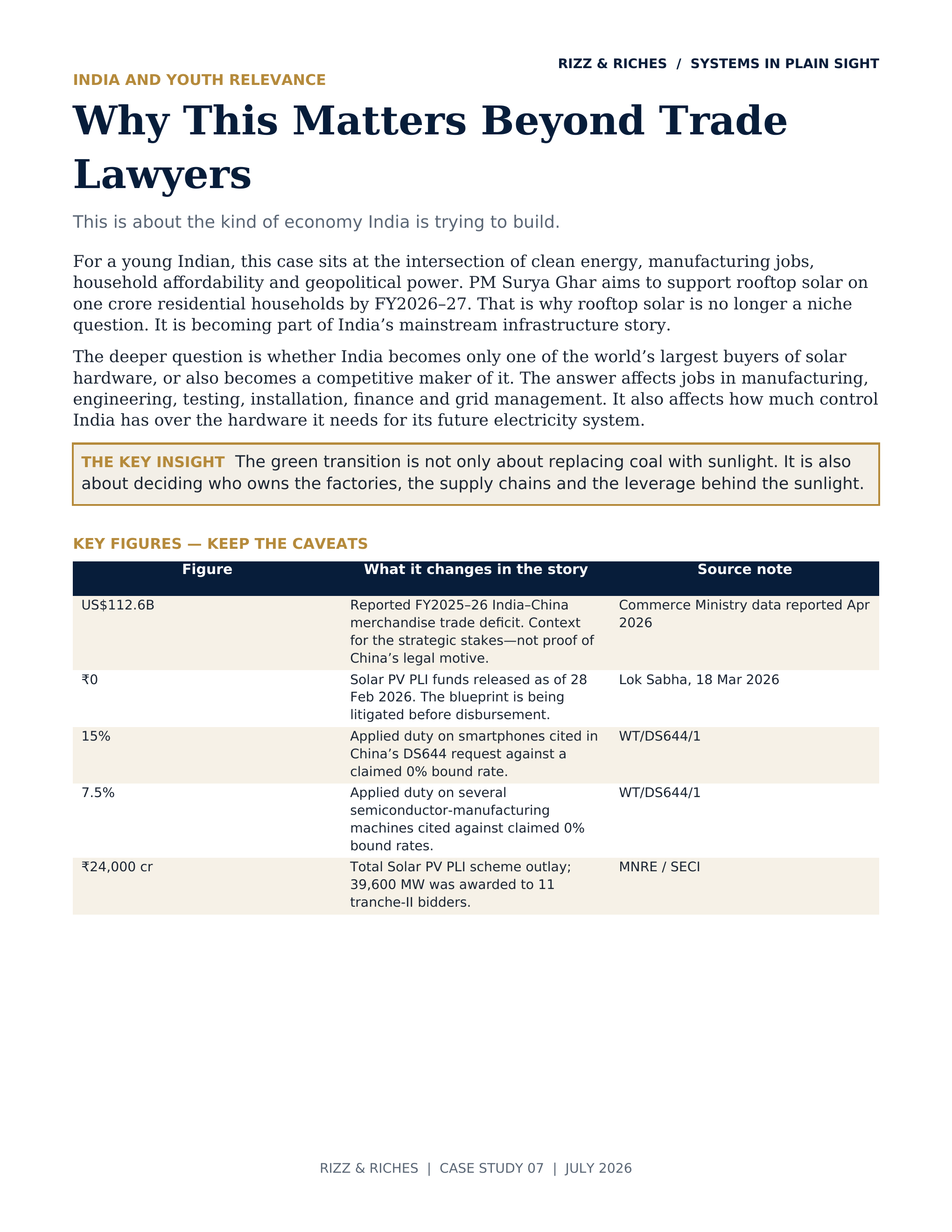
Key figures from the document:
- US$112.6B: reported FY2025-26 India-China merchandise trade deficit. This is context for the strategic stakes, not proof of China’s legal motive.
- Rs 0: Solar PV PLI funds released as of 28 February 2026.
- 15%: applied duty on smartphones cited in China’s DS644 request against a claimed 0% bound rate.
- 7.5%: applied duty on several semiconductor-manufacturing machines cited against claimed 0% bound rates.
- Rs 24,000 crore: total Solar PV PLI scheme outlay; 39,600 MW was awarded to 11 Tranche-II bidders.
Sources and Further Reading
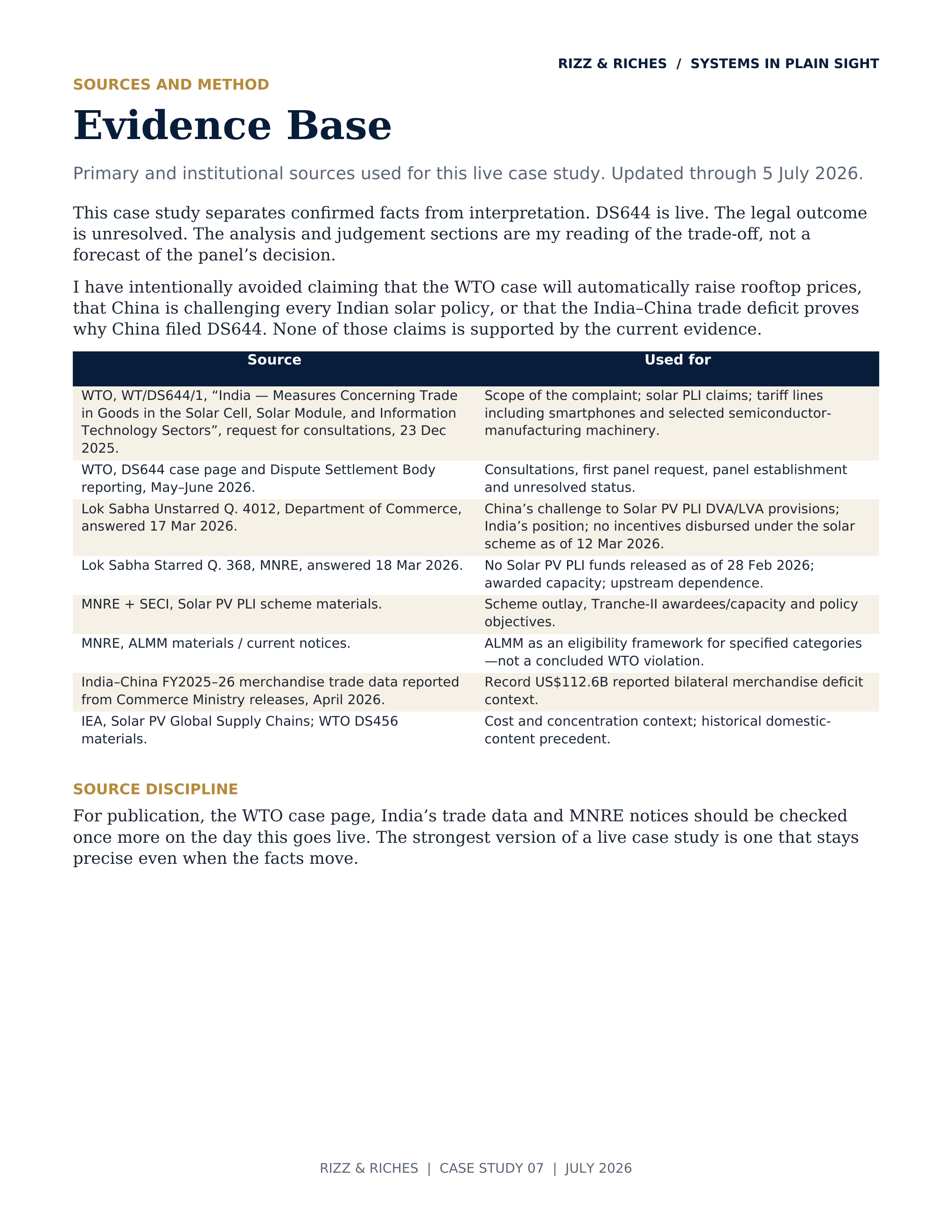
This live case study separates confirmed facts from interpretation. DS644 is live. The legal outcome is unresolved. The analysis and judgement sections are a reading of the trade-off, not a forecast of the panel’s decision.
It intentionally avoids claiming that the WTO case will automatically raise rooftop prices, that China is challenging every Indian solar policy, or that the India-China trade deficit proves why China filed DS644. None of those claims is supported by the current evidence.
- WTO, WT/DS644/1, “India - Measures Concerning Trade in Goods in the Solar Cell, Solar Module, and Information Technology Sectors”, request for consultations, 23 Dec 2025.
- WTO, DS644 case page and Dispute Settlement Body reporting, May-June 2026.
- Lok Sabha Unstarred Q. 4012, Department of Commerce, answered 17 Mar 2026.
- Lok Sabha Starred Q. 368, MNRE, answered 18 Mar 2026.
- MNRE + SECI, Solar PV PLI scheme materials.
- MNRE, ALMM materials / current notices.
- India-China FY2025-26 merchandise trade data reported from Commerce Ministry releases, April 2026.
- IEA, Solar PV Global Supply Chains; WTO DS456 materials.
Source discipline: for publication, the WTO case page, India’s trade data and MNRE notices should be checked once more on the day this goes live. The strongest version of a live case study is one that stays precise even when the facts move.
Visual appendix
Figures and original visual plates
High-resolution image exports from the supplied case-study document. Dense figures can be opened full-size for closer reading.